
- A sealed, reproducible release with manifest-first verification and public archival DOIs.
- This document defines FTU (Fadi Tempo Unit) as a canonical base time unit for FTU-compliant specifications and implementations.
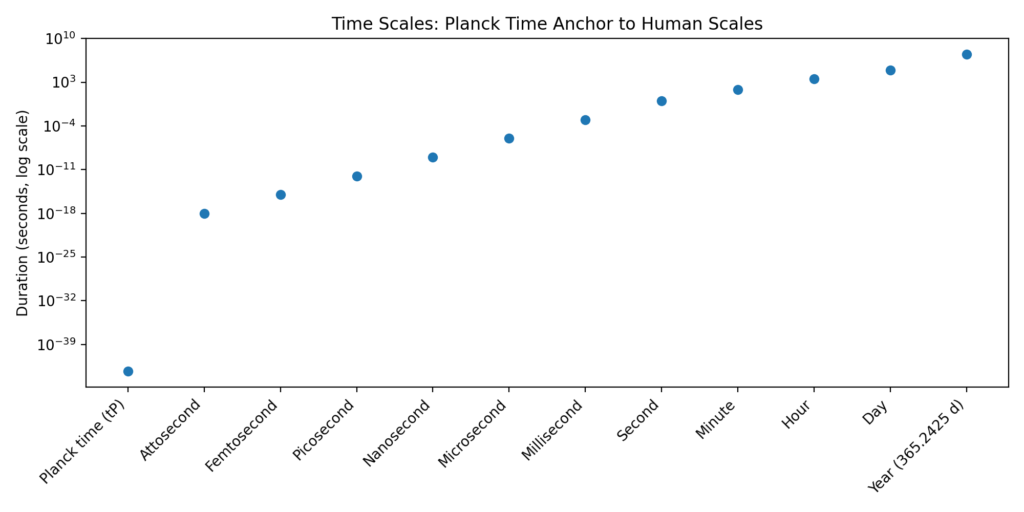
- FTU is normatively defined to be equal to Planck time (*tₚ*), and provides conversion rules for:
- Durations ↔ FTU counts
- Frequencies (Hz) ↔ FTU-period counts
- Domain tempo units (DTU) as declared multiples of FTU for hardware/biological clocks
- Compliance metadata exposure for machine verification (file or /.well-known endpoint)
- Normative conformance vectors for testability
- This specification is designed for machine-ingestible reproducibility: it pairs naturally with a reference implementation (ftu-core),
- conformance vectors (ftu-test), and a public verifier (ftu-verify) bound by a signed Master Manifest.
FAQ
What is FTU?
Problem, Solution, Why Now (NON‑NORMATIVE)
- Problem. Modern systems (AI, telemetry, media pipelines, sensors, distributed logs) often use incompatible “ticks” and hidden assumptions when stating durations, rates, and timing claims. This makes cross-system results hard to compare, reproduce, or audit.
- Solution. FTU provides a canonical base tick anchored to Planck time (*tₚ*), plus explicit rules for:
- converting between seconds ↔ FTU without ambiguity,
- publishing Domain Tempo Units (DTU) as exact FTU multiples for real-world clocks,
- shipping machine-verifiable manifests + conformance vectors so any third party can verify the release.
- Why now. Verification is becoming the default expectation: standards that are hash-addressable, reproducible, and independently checkable adopt faster than narrative-only documents.
- Design goals
- Interoperability: consistent timing claims across domains and stacks.
- Auditability: independent verification without private context.
- Disclosure: constants and assumptions must be explicit and testable.
- Longevity: stable references suitable for long-horizon archival citation.
- Non-goals
- Proposing “new physics,” replacing SI, or claiming empirical discreteness of time.
- Forcing a single implementation language or platform.
- Substituting for uncertainty analysis in measurements (FTU is a canonicalization layer).
Verify in 30 seconds (copy/paste):
Verification Endpoints (public)
- GULF Law domain: https://gulflaw.org/.well-known/ftu/ftu_manifest.json
- Slash Turbo domain: https://slashturbo.com/.well-known/ftu/ftu_meta.json
curl -sL -H 'Accept-Encoding: identity' https://gulflaw.org/.well-known/ftu/ftu_manifest.json -o /tmp/ftu_manifest.json
sha256sum /tmp/ftu_manifest.json
Canonical citations
- Zenodo DOI (primary):
10.5281/zenodo.18110197DOI - OSF DOI (mirror):
10.17605/OSF.IO/JVRCQDOI - GULF Law core DOI:
10.5281/zenodo.16748414Zenodo
What this connects to (cross-linking)
Canonical Citations — GULF Law ↔ FTU Spec (Maintained by Fadi Ghali)
Identity
- ORCID: 0009-0001-8892-2338 (Fadi Ghali) ✅ referenced in Zenodo records
FTU Spec — Flagship Release
- GitHub release tag: v1.7.1-zenodo1: https://github.com/fghali/ftu-spec/releases/tag/v1.7.1-zenodo1
- Zenodo (software record, DOI): https://doi.org/10.5281/zenodo.18110197
- OSF (archival component, DOI): https://doi.org/10.17605/OSF.IO/JVRCQ
GULF Law (Core public DOI)
- “Frequency Cure: The Blueprint for Healing Humanity’s Deepest Pains”
The Resonance Standard: GULF Law and the Empirically Referenced Science of Frequency for Real-Time Human Safety:
https://doi.org/10.5281/zenodo.16748414
Full citation index: gulflaw.org/citations/